lun
mar
mer
jeu
ven
sam
dim
l
m
m
j
v
s
d
26
28
29
30
31
1
2
3
4
12:00 AM - 3eme Journée Deep Learning pour la Science
12:00 PM - Déjeuner de l'IA
7
8
9
13
14
15
10:00 AM - SEmantic web SeminAr MontpEllier
17
12:00 AM - MedTech_IA
20
21
22
23
25
9:00 AM - BATISSEURS DE FUTURS OCCITANIE (Acte 3)
28
29
30
2
4
5
6
Online
Machine Learning in Montpellier, Theory & Practice - Pedro Valdeira (Carnegie Mellon)
Vertical federated learning trains models from feature-partitioned datasets across multiple clients, who collaborate without sharing their local data. Standard approaches assume that all feature partitions are available during both training and inference. Yet, in practice, this assumption rarely holds, as for many samples only a subset of the clients observe their partition. However, not utilizing incomplete samples during training harms generalization, and not supporting them during inference limits the utility of the model. Moreover, if any client leaves the federation after training, its partition becomes unavailable, rendering the learned model unusable. Missing feature blocks are therefore a key challenge limiting the applicability of vertical federated learning in real-world scenarios. To address this, we propose LASER VFL, a vertical federated learning method for efficient training and inference of split neural network-based models that is capable of handling arbitrary sets of partitions. Our approach is simple yet effective, relying on the sharing of model parameters and on task-sampling to train a family of predictors. We show that LASER-VFL achieves a convergence rate for nonconvex objectives and, under the Polyak-Łojasiewicz inequality, it achieves linear convergence to a neighborhood of the optimum. Numerical experiments show improved performance of LASER-VFL over the baselines. Remarkably, this is the case even in the absence of missing features. For example, for CIFAR-100, we see an improvement in accuracy of % when each of four feature blocks is observed with a probability of 0.5 and of % when all features are observed. The code for this work is available at https://isdm.umontpellier.fr/github.com/Valdeira/LASER-VFL.
Machine Learning in Montpellier, Theory & Practice

Machine Learning in Montpellier, Theory & Practice - Pedro Valdeira
Vertical federated learning trains models from feature-partitioned datasets across multiple clients, who collaborate without sharing their local data. Standard approaches assume that all feature partitions are available during both training and inference. Yet, in practice, this assumption rarely holds, as for many samples only a subset of the clients observe their partition. However, not utilizing incomplete samples during training harms generalization, and not supporting them during inference limits the utility of the model. [...]
Vertical Federated Learning, Missing Feature Blocks, LabéliséHallesIA

UM - Polytech
NumDiag
Cette année encore, nous vous donnons rendez-vous pour une journée de réflexion interdisciplinaire sur le thème : IA, cybersécurité et protection des données - quels liens, quels enjeux ? L'évènement aura lieu dans les locaux de Polytech Montpellier de l'Université de Montpellier mais sera également accessible en visio.
Cette manifestation est organisée avec le soutien de Institut Cybersécurité Occitanie (ICO), LIRMM, ISDM.
Réflexion, Interdisciplinaire, IA, Cybersécurité, LabéliséHallesIA
Siège du CNRS - Paris Michel-Ange
3 rue Michel-Ange - 75794 Paris cedex 16

L'IDRIS et l'ANF CNRS FIDLE organisent la troisième Journée Deep Learning pour la Science (JDLS) en partenariat avec l'Université de Montpellier (ISDM).
L'objectif de cette journée est de favoriser le partage des expériences dans l'utilisation des outils d'intelligence artificielle dans le domaine scientifique, toutes communautés confondues. Cette journée est ouverte à tous.tes, gratuitement sur inscription uniquement.
#Journée, #DeepLearning, #Science, #OutilsIA

Broc Café
Nous vous invitons à partager un repas convivial tout en discutant des projets et des dynamiques autour de l’IA sur Montpellier.Ce moment sera aussi l’occasion d’aborder les projets en cours et à venir portés par l’association, ainsi que ceux portés par vos structures.
La première consommation est offerte par Les Halles de l'IA. (Le plat reste à la charge des participants.) Places limitées
Réseautage, IA, Rencontres, LabéliséHallesIA

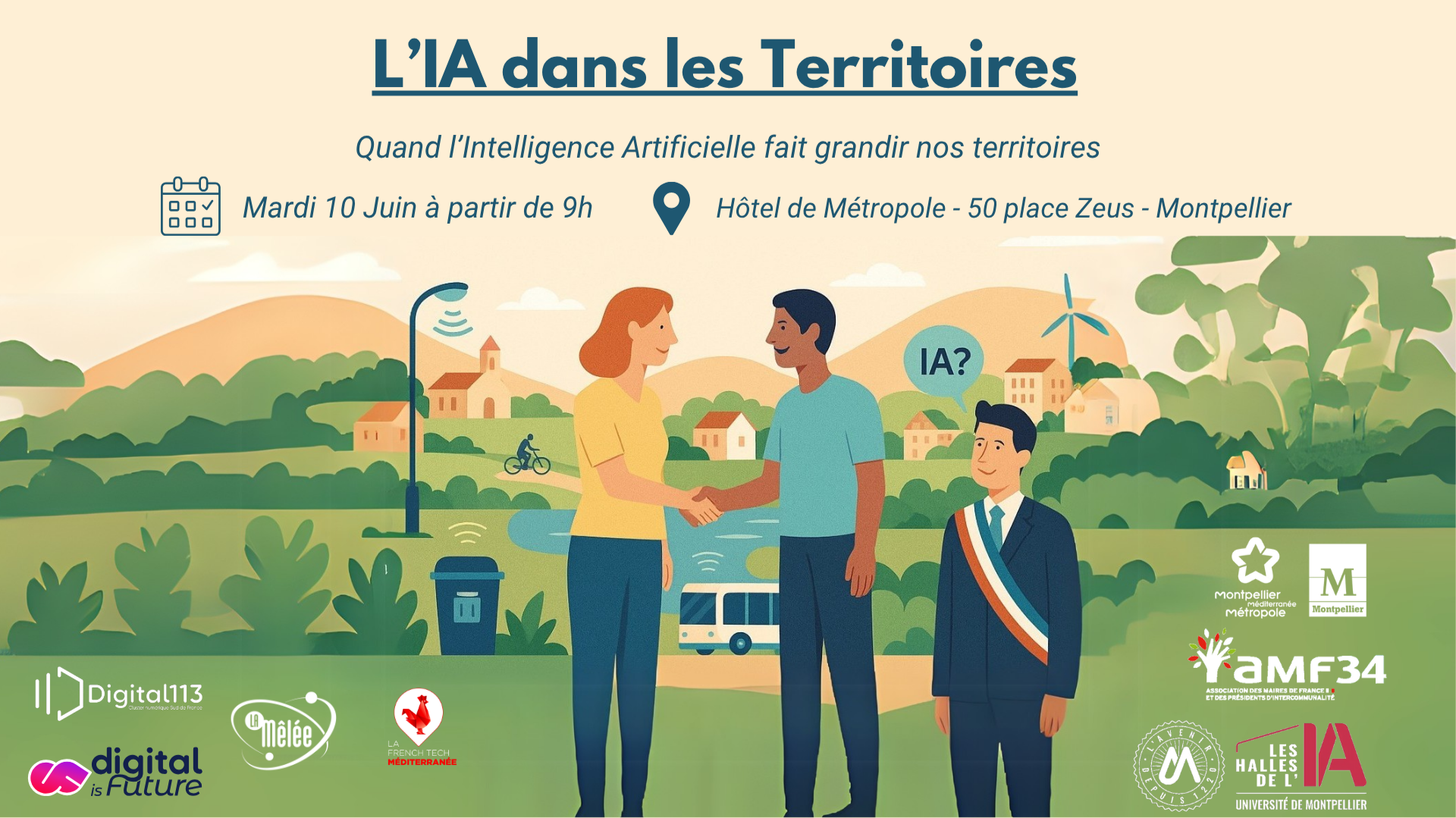
Salle du Conseil, Hôtel de Métropole, 50 Place de Zeus, Montpellier
Montpellier Méditerranée Métropole
Journée d’échanges et de prospective pour les collectivités territoriales de l’Hérault.
LabéliséHallesIA
Online
Machine Learning in Montpellier, Theory & Practice - Emma Torrini (Universita degli studi Firenze)
The presence of intermediate variables that occur after treatment assignment and potentially influence the outcome complicates the estimation of causal effects, even in randomized trials. Principal stratification is a methodology employed to estimate the causal effect of a treatment on an outcome in the presence of such intermediate variables. This approach involves the cross-classification of units into latent groups, referred to as principal strata, which are defined by the potential values of the intermediate variable under treatment and control conditions. The focus is on estimating principal causal effects, which are causal effects within these principal strata. The identification of principal causal effects can be achieved through various methods, one of which is the principal score method. At present, principal score methods are available for a binary treatment, binary intermediate variable, and binary/continuous/survival outcome. Motivated by a cardiovascular randomized trial, we take an initial step towards integrating a survival intermediate variable into principal score methods.
Machine Learning in Montpellier, Theory & Practice
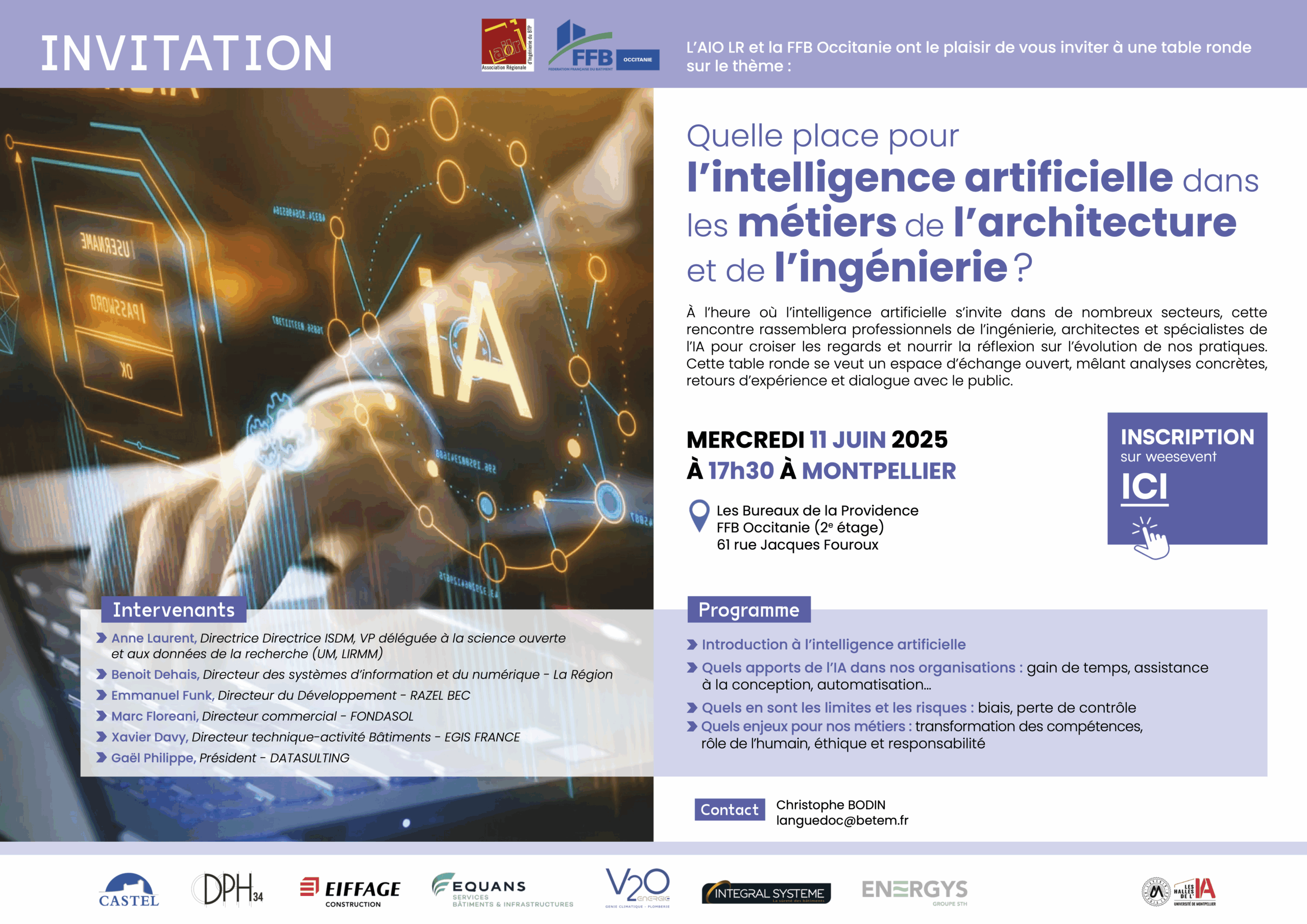
FFB Occitanie (2e étage), 61 rue Jacques Fouroux, Montpellier
L’AIO LR et la FFB Occitanie
À l’heure où l’intelligence artificielle s’invite dans de nombreux secteurs, cette rencontre rassemblera professionnels de l’ingénierie, architectes et spécialistes de l’IA pour croiser les regards et nourrir la réflexion sur l’évolution de nos pratiques. Cette table ronde se veut un espace d’échange ouvert, mêlant analyses concrètes, retours d’expérience et dialogue avec le public.
Professionnels, Ingénierie, Architecte, LabéliséHallesIA
Room 02.124, Building 5, St Priest campus
Machine Learning in Montpellier, Theory & Practice - Martin Van Waerebeke (Inria)
Machine Unlearning (MU) aims at removing the influence of specific data points from a trained model, striving to achieve this at a fraction of the cost of full model retraining. In this paper, we analyze the efficiency of unlearning methods and establish the first upper and lower bounds on minimax computation times for this problem, characterizing the performance of the most efficient algorithm against the most difficult objective function. Specifically, for strongly convex objective functions and under the assumption that the forget data is inaccessible to the unlearning method, we provide a phase diagram for the unlearning complexity ratio---a novel metric that compares the computational cost of the best unlearning method to full model retraining. The phase diagram reveals three distinct regimes: one where unlearning at a reduced cost is infeasible, another where unlearning is trivial because adding noise suffices, and a third where unlearning achieves significant computational advantages over retraining. These findings highlight the critical role of factors such as data dimensionality, the number of samples to forget, and privacy constraints in determining the practical feasibility of unlearning.
Machine Learning in Montpellier, Theory & Practice

Salle 104 du bâtiment 11 dit le château, 2 Place Pierre Viala Campus La Gaillarde, 34000 Montpellier
SEmantic web SeminAr MontpEllier
Le séminaire commencera par un café offert par les Halles de l'IA. Au programme :
(1) News du W3C en 10 minutes, par Pierre-Antoine CHAMPIN, W3C / INRIA / Université de Lyon
(2) FAIRiser les données du réseau d’observatoires de la zone critique Français (OZCAR) : cas d’utilisation de l’ontologie I-ADOPT par Charly COUSSOT, IRD Université Grenoble Auvergne Rhône Alpes
LabéliséHallesIA

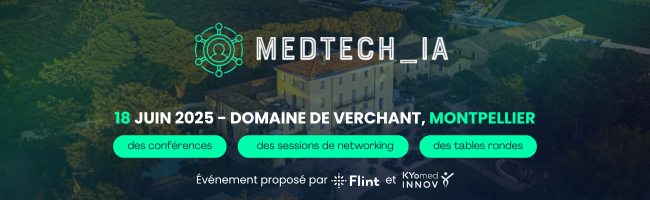
Le Domaine de Verchant, à Montpellier
KYomed INNOV et Flint
MedTech_IA, l'évènement sur des cas d'usages concrets de l'utilisation de l'IA dans la MedTech.
Un événement à l'échelle nationale.
Plus de 200 participants attendus (CEO, CDO, CTO ...).
Une journée complète de conférences et tables rondes avec une 20aine de speakers experts venus de toute la France.
Des sponsors et partenaires nationaux qui nous soutiennent.
MedTech_IA, Santé, IA, Conférences, LabéliséHallesIA
Room 02.124, Building 5, St Priest campus
Machine Learning in Montpellier, Theory & Practice - Vincent Divol (ENSAE/CREST)
Algorithms are now routinely used to help make decisions in areas like hiring, school admissions, and healthcare. These tools can be helpful (they are fast and can handle lots of data) but they alsocome with risks. If the data they are trained on reflect unfair patterns from the past, the algorithms can end up repeating those same patterns. In this talk, I will introduce a way to think about and improve fairness in algorithms, called statistical fairness. I will focus on one idea in particular: demographic parity. This is the idea that an algorithm’s predictions should be spread out similarly across different groups (for example, different genders or ethnicities) regardless of other differences between them. I will present recent results on regression problems subject to a demographic parity constraint. I will focus in particular on the unaware setting, where the sensitive attribute (such as gender or race) cannot be used in decision-making—either because it is unavailable or because its use is restricted by law. Joint work with Solenne Gaucher (CMAP)
Machine Learning in Montpellier, Theory & Practice
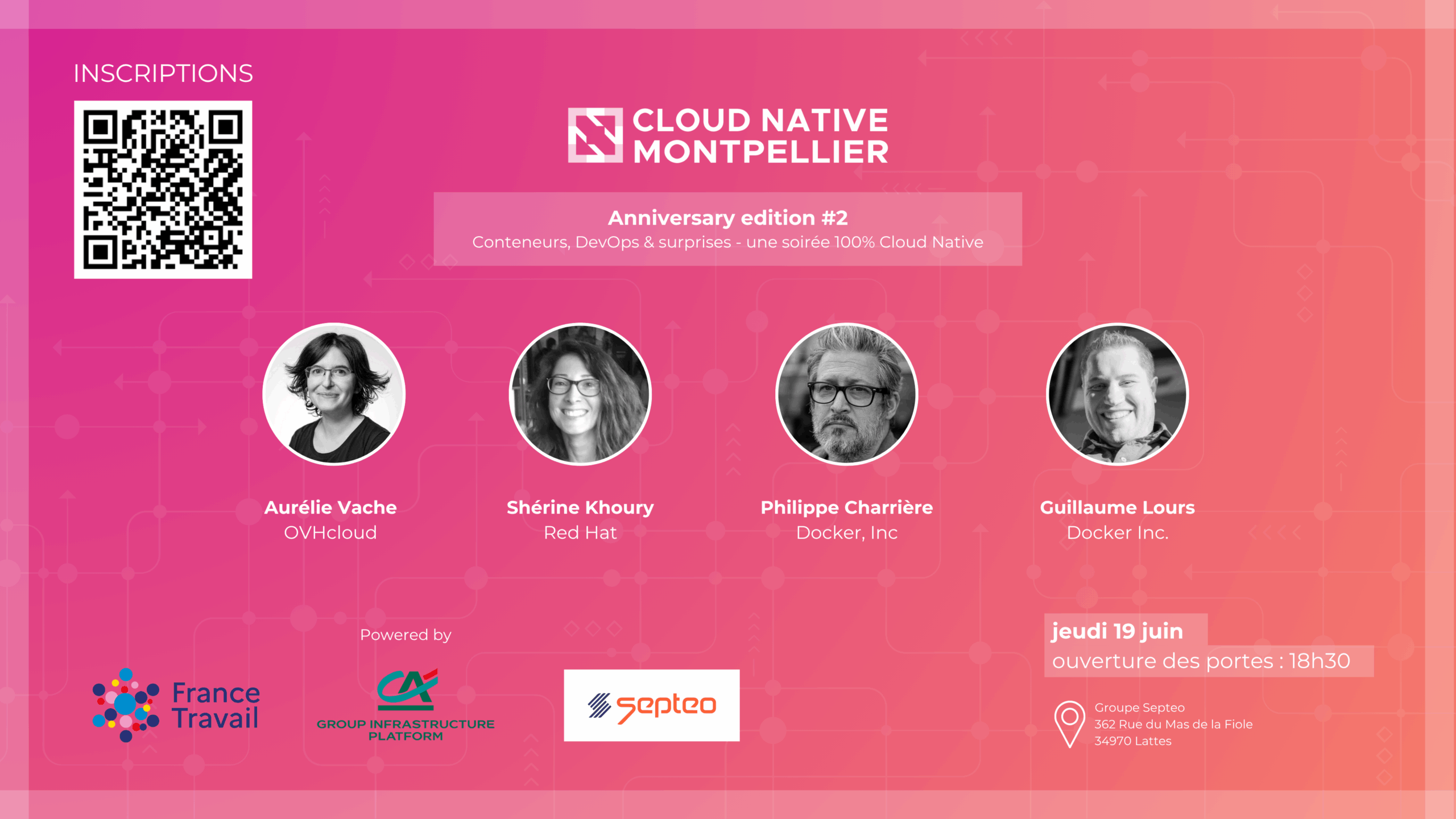
Groupe Septeo, 362 Rue du Mas de la Fiole, Lattes
Cloud Native Montpellier
Cloud Native Montpellier fête ses 2 ans et nous avons préparé une soirée très spéciale. 4 speakers de renom dans le monde du Cloud et des animations sont au programme. Si il y a une soirée à laquelle il faut participer, c'est bien celle-là !
Cloud Native Montpellier, Anniversaire, Cloud, Animations, LabéliséHallesIA
Room 02.124, Building 5, St Priest campus
Machine Learning in Montpellier, Theory & Practice - Eddie Aamari (CNRS)
The aim of this talk is to introduce generative models based on diffusions. After a brief reminder of the key concepts of stochastic calculus, we'll detail how a time-reversed Ornstein-Uhlenbeck process can be used to transport distributions when starting from a Gaussian source. As this reversed process involves the so-called score function, we will then address the question of score learning via the minimization of an empirical contrast. Finally, we'll discuss the stability of such a method, as well as minimax estimation speeds if time permits. Notes are available [ https://isdm.umontpellier.fr/www.math.ens.psl.eu/~eaamari/files/Diffusion-based%20generative%20modeling%20-%20For%20statisticians%20and%20probabilists.pdf | here ] .
Machine Learning in Montpellier, Theory & Practice

Institut de Botanique de Montpellier
Service des Usages du Numérique de l'Université de Montpellier et le réseau IA4Sup
Le 26 juin 2025, une journée dédiée à l'IA et l'Évaluation explore un sujet de forte préoccupation pour les enseignants et les étudiants à l'heure du développement de l'intelligence artificielle. Des présentations et conférences d'experts nationaux et internationaux, avec Jacques Tardif (Université de Sherbrooke), Jean-François Van de Poël (Université de Lausanne), Nejma Belkhdim (Nolej) et Christophe Batier (Université de Lyon 1 - réseau IA4Sup). Des retours d'expériences par les enseignants de l'Université de Montpellier ayant expérimenté l'usage des IA dans leur enseignement. Des ateliers pratiques en petits groupes en lien avec le thème de la journée IA et Évaluation. Des présentations de solutions numériques exploitant l'IA (Nolej, Challenge Me, Wooclap-Wooflash).
IA, Évaluation, Enseignement supérieur, Étudiants, LabéliséHallesIA

FFB Occitanie, 155 rue Jacques Fouroux
FFB Occitanie - SMABTP - DIGITAL 113
L'objectif de la matinée est de permettre aux professionnels de comprendre les enjeux, d'adopter les bons outils et de se prémunir efficacement contre les cyberattaques qui finalement concernent toutes les entreprises de toutes tailles.
Outils, IA, Cyberattaques, Entreprises, Bâtiment, LabéliséHallesIA
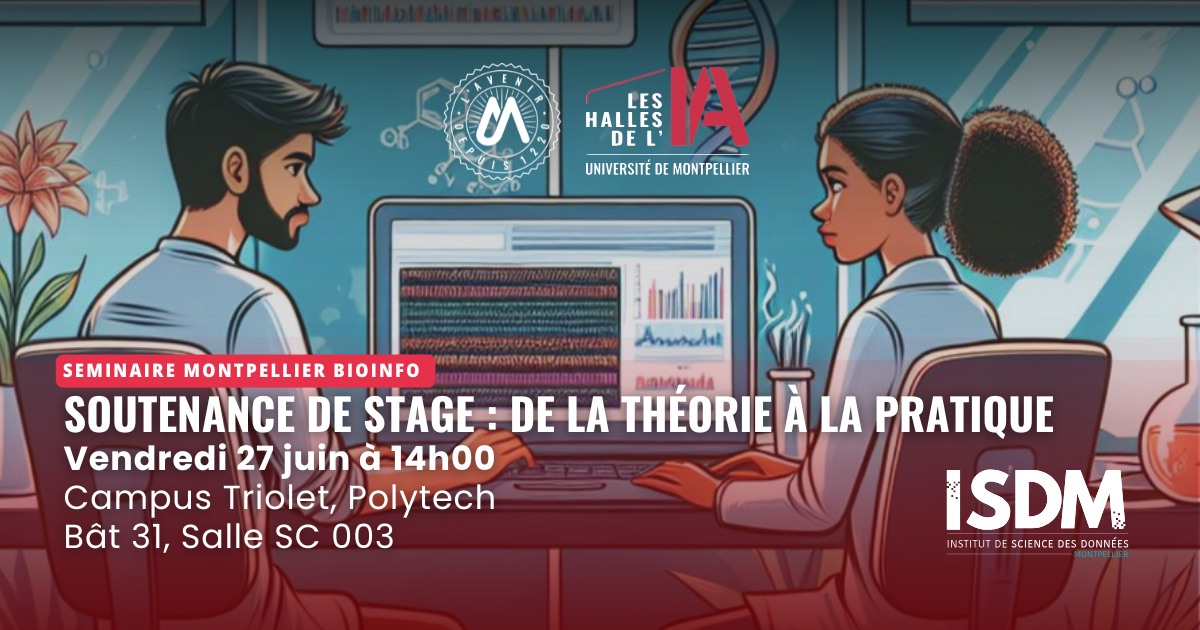
Salle SC 003, Bâtiment 31, Polytech, Campus Triolet
Équipe Montpellier BioInfo
C’est l’occasion pour les étudiants de Master 1 et 2 en bioinfo de présenter l’avancée de leur stage, en vue de leur soutenance. L'objectif : s’entraîner à l’oral, partager ses travaux et recevoir des retours constructifs dans une ambiance bienveillant. Quelques sujets au programme : développement de l'outil INpalm pour prédire les émissions d’azote, étude de la frustration locale des protéines et analyse de l’impact du génome de référence sur le mapping et l’hétérozygotie en génomique et bien d’autres encore ! Venez nombreux pour encourager les présentateurs et découvrir la diversité des projets.
Master1et2, BioInfo, Stage, LabéliséHallesIA

Faculté de droit de l’Université de Montpellier (salle des actes et cloître)
In Limine Litis avec la Faculté de Droit et de Science politique de l'Université de Montpellier, Montpellier ville de droit et avec l'aide de CONTEXT'ART
L’intelligence artificielle bouleverse nos modèles traditionnels de création, d’innovation et de protection. Elle génère, assiste… mais interroge surtout notre rapport au droit, à l’éthique, et à la créativité. Le temps d’une fin d’après-midi, ce sujet au cœur de l’actualité, sera exploré par des intervenants issus du monde juridique, académique, entrepreneurial et culturel. Entrée sur inscription (places limitées à 50).
IA, Innovation, Création, Droit
Room 02.124, Building 5, St Priest campus
Machine Learning in Montpellier, Theory & Practice - Julien Patras (IRD / Marbec)
Seabirds serve as key bioindicators of ocean health, and with modern tracking technologies like GPS tags, we now have rich datasets capturing their offshore movements. These trajectory data enable us to study behavioral states and identify ecologically significant foraging zones. However, modeling how environmental variables (like wind, sea surface temperature, or currents) shape these trajectories remains largely unexplored. Trajectory simulation using generative artificial intelligence has shown great promise in fields like autonomous driving and human motion modeling. Inspired by these advances, we introduce a novel approach in movement ecology by adapting DiffTraj (Zhu et al., 2023), a pretrained diffusion model originally developed for vehicle trajectories. We then adapt and fine-tune the model on seabird movement data, so that it supports multi-species, multi-site simulation, with the aim of environmental conditioned generation, and improving state-of-the-art seabird trajectory simulation.
Machine Learning in Montpellier, Theory & Practice
Room 02.124, Building 5, St Priest campus
Machine Learning in Montpellier, Theory & Practice - Loic Landrieu (LIGM, ENPC, IP Paris, Univ Gustave Eiffel)
Machine Learning in Montpellier, Theory & Practice
Campus St Priest (860 Rue Saint Priest 34095 Montpellier Cedex 5), bat. 5, Room: 02.124
Machine Learning in Montpellier, Theory & Practice - Pedro Valdeira
Julien Patras (IRD / Marbec) will give a talk : Seabirds serve as key bioindicators of ocean health, and with modern tracking technologies like GPS tags, we now have rich datasets capturing their offshore movements. These trajectory data enable us to study behavioral states and identify ecologically significant foraging zones. However, modeling how environmental variables (like wind, sea surface temperature, or currents) shape these trajectories remains largely unexplored. Trajectory simulation using generative artificial intelligence has shown great promise in fields like autonomous driving and human motion modeling. Inspired by these advances, we introduce a novel approach in movement ecology by adapting DiffTraj (Zhu et al., 2023),a pretrained diffusion model originally developed for vehicle trajectories. We then adapt and fine-tune the model on seabird movement data, so that it supports multi-species, multi-site simulation, with the aim of environmental conditioned generation, and improving state-of-the-art seabird trajectory simulation.
Seabirds, Trajectories, Environmental variables, LabéliséHallesIA