
lun
mar
mer
jeu
ven
sam
dim
l
m
m
j
v
s
d
27
28
29
30
1
2
12:00 AM - Montpellier Omics Days 2025
5
11:00 AM - Construisez votre Plan d'action IA 2025
12:00 PM - Déjeuner de l'IA (deuxième édition)
8
9
11
12
14
2:30 PM - Prise de décision collective
16
10:00 AM - The EU Rail Knowledge Graph
2:00 PM - Montpellier IA CONNECT
18
19
20
21
23
25
26
27
28
1
2

JJ Moreau, campus Saint Priest de l’Université de Montpellier, bâtiment 2
Prof. Jean-Gabriel Ganascia
In collaboration with the AI Transversal Axis of LIRMM and the EU AI4CCAM project, Professor Jean Gabriel Ganascia will give a lecture titled "The braided structure of time in AI and information technologies" at LIRMM. The lecture will be followed by light refreshments.
Professor Ganascia is a renowned authority in Artificial Intelligence and Ethics. He is a Professor of Computer Science at the Faculty of Sciences of Sorbonne University and senior member of the Institut Universitaire de France. He is a EurAI Fellow – European Association for Artificial Intelligence and is currently the president of the Ethical Committee of CNRS.
AI, Technologies, Computer Science at the Faculty

Locaux historiques de la faculté de Médecine de Montpellier
Collège des Sociétés Savantes Académiques de France
Le congrès annuel du Collège est un moment privilégié pour établir des contacts informels, pour tirer partie de notre diversité et pour valider les orientations stratégiques du Collège.
Il se compose d’une demi-journée réservée aux aux représentantes officielles et représentants officiels des membres du Collège (Lundi 3 février après-midi, Université Paul-Valéry-Montpellier, campus Saint-Charles, Avenue Saint Charles) et d’une journée académique (Mardi 4 février, Université de Montpellier, Amphithéatre d’anatomie, bâtiment historique de la faculté de médecine, Rue de l’école de médecine; ouverte à l’ensemble de la communauté académique sur inscription) portant sur un thème transverse à la communauté académique, cette année: «Sciences, responsabilité et engagement : quelles stratégies pour compter dans l’action publique ?».
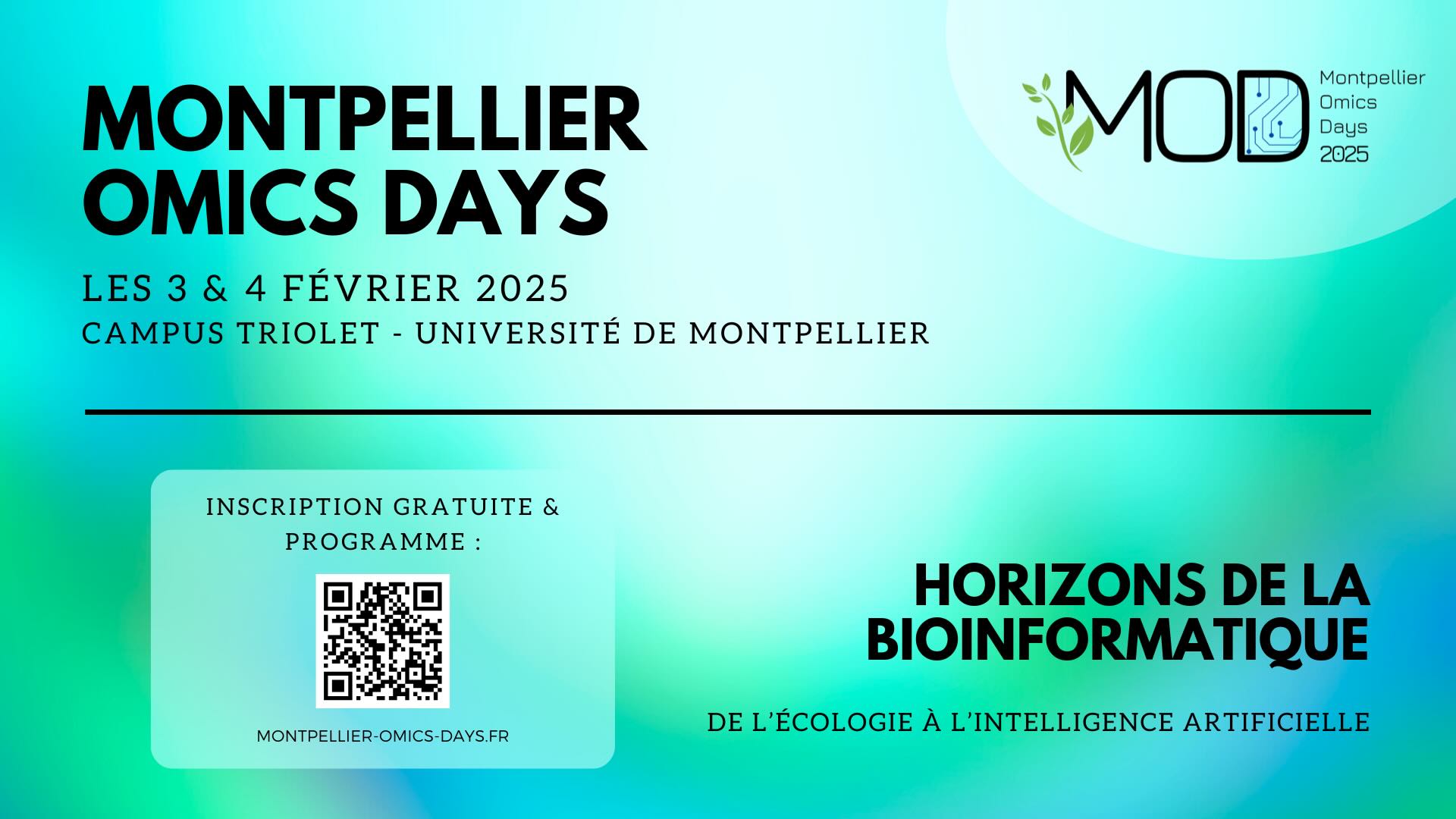
Campus Triolet, Université de Montpellier
Les étudiants du Master 2 Bioinformatique
Plongez dans l'univers de la bioinformatique et des sciences omiques lors des Montpellier Omics Days, les 3 et 4 février 2025, sur le Campus Triolet de l'Université de Montpellier.Cet événement, organisé par les étudiants du Master 2 Bioinformatique, est l'occasion d'explorer les nouveaux horizons de la bioinformatique, allant de l'écologie à l'intelligence artificielle.
Que vous soyez étudiant, chercheur ou professionnel passionné par la bioinformatique et ses applications, cet événement est fait pour vous !
LabéliséHallesIA
Online
Machine Learning in Montpellier, Theory & Practice
This talk examines two critical aspects of data-driven medicine: personalized treatment strategies using causal inference and the robust evaluation of large language models (LLMs) for clinical applications. In the first part, we present a novel approach to personalized medicine, applying causal statistical learning to observational data to develop individualized treatment rules. We focus on optimizing the timing of renal replacement therapy initiation in acute kidney injury, demonstrating: (i) the estimation and validation of an optimal dynamic strategy, and (ii) a comprehensive framework for evaluating individualized rules using observational data. In the second part, we tackle the challenge of evaluating LLMs in medicine, focusing on the generation of hospital course summaries. Current evaluation methods are often either unscalable (physician-led) or untrustworthy for clinical settings (LLM-as-a-judge). We propose a rubric-based approach to LLM evaluation that combines the scalability of automated methods with the trustworthiness demanded by medical applications, paving the way for responsible deployment of LLMs in healthcare.
Machine Learning in Montpellier, Theory & Practice

Datasulting - 187 Rue Helene Boucher, 34170 Castelnau-le-Lez
Cet atelier portera sur la planification et le déploiement de vos projets en IA Générative pour 2025. Deux de nos experts interviendront lors de cet événement : Luc Maurette, Consultant en data et IA -
Camille Morelon, Directrice Data.
Venez avec vos questions, repartez avec des idées et des solutions concrètes grâce à de riches échanges avec nos experts !
Public cible : PME / ETI
sous réserve de validation par l’organisateur
Seulement 15 participants, inscrivez-vous rapidement !
LabéliséHallesIA
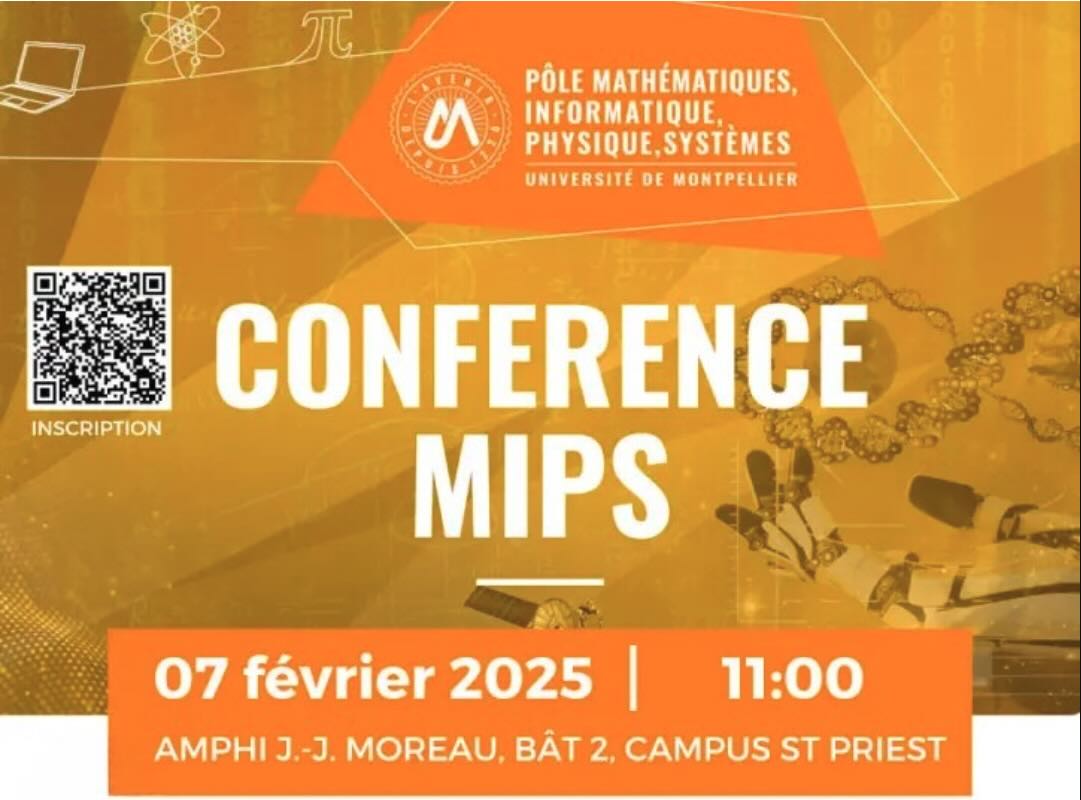
Campus St Priest - Bât 2 - Amphithéâtre Moreau - 860, rue de St Priest 34090 Montpellier
Konstantin TODOROV, LIRMM
How do falsehoods spread on the web? This question, tied to the spread of fake newsand biased discourse, has gained interest across fields from social sciences to AI.Online discourse—claims and opinions shared online with their contexts (authors,entities, events)—offers valuable insights.

Broc Café – Montpellier
Les Halles de l'IA
Pour cette 2ᵉ édition du Déjeuner de l'IA, nous vous invitons à partager un repas convivial tout en discutant des projets et des dynamiques IA sur Montpellier. Comme lors de la première édition, cet événement est l’occasion idéale pour : (1) Rencontrer des acteurs locaux de l’IA (2) Découvrir de nouvelles initiatives (3) Partager vos idées et projets !
Au programme :
• "Pitch ton projet en 2 minutes" : 5 participants seront sélectionnés pour présenter leurs projets IA sur des thématiques variées.
• De grandes annonces à venir sur les dynamiques IA sur Montpellier....
La première consommation est offerte par Les Halles de l'IA. (Le plat reste à la charge des participants.)
Places limitées
Room 02.124, Building 5, St Priest campus
Machine Learning in Montpellier, Theory & Practice
Bilevel problems are optimization problems characterized by a hierarchical structure. In these problems, one seeks to minimize an outer function subject to the constraint that certain variables minimize an inner function. These problems are gaining popularity in the machine learning community due to their wide range of applications, such as hyperparameter optimization and data reweighting. In this talk, we introduce bilevel optimization and demonstrate how various machine learning problems can be formulated within this framework. We then focus on the algorithmic aspects of solving bilevel problems. Specifically, we present a general algorithmic framework that enables the adaptation of first-order stochastic solvers—originally designed for single-level problems—to the bilevel setting. We provide theoretical guarantees for specific instances of this framework and present a numerical benchmark comparing bilevel optimization methods.
Machine Learning in Montpellier, Theory & Practice

Inria Montpellier, St-Priest Campus, Building 5, Room 01/124
Machine Learning in Montpellier, Theory & Practice
Data.table is one of the most efficient open-source in-memory data manipulation packages available today. First released to CRAN by Matt Dowle in 2006, it continues to grow in popularity, and now over 1500 other CRAN packages depend on data.table. This talk will start with data reading from CSV, discuss basic and advanced data manipulation topics, and finally will end with a discussion about how you can contribute to data.table.
https://github.com/tdhock/2023-10-LatinR-data.table?tab=readme-ov-file#source-files-for-latinr-datatable-tutorial-slides
LabéliséHallesIA
Médiathèque William Shakespeare
Ganesh Gowrishankar et Madalina Croitoru (équipe IDH du LIRMM / Université de Montpellier)
Dans le cadre des Mycéliades. Explorez les mécanismes de prise de décision collective. Grâce à des jeux interactifs, découvrez comment les décisions peuvent être manipulées et les résultats modifiés par les coalitions.
Dès 12 ans. Inscriptions à partir du samedi 1er février sur place ou par téléphone au 04 67 16 34 20
Salle 104 du bâtiment 11 dit le château, 2 Place Pierre Viala Campus La Gaillarde, 34000 Montpellier
SESAME - SEmantic web SeminAr MontpEllier
The European Union Agency for Railways (ERA) is an Agency in charge of facilitating the implementation of an efficient, safe, and interoperable rail transport across member states in Europe. To this end, ERA maintains different registers with legal mandate covering different domains of railway (infrastructure, rolling stock, signalling, safety, humans, etc). Since 2020, ERA has adopted a data-centric organisation strategy, which includes leveraging semantic web technology to the different registers.
This talk will dive deeper into the current implementation as knowledge graph of two registers: the register of infrastructure (RINF) and the European Register of Authorised Types of Vehicles (ERATV). I will focus on the ontology development, the process management of the 50+ classes and 461 properties; as well as the SHACL rules (around 100). The talk will also showcase two applications consuming the knowledge graph – one for data retrieval for non SPARQL experts and the route compatibility check to answer if a certain railway vehicle can travel the route between two operational points. The talk will also highlight some challenges faced by a public authority when adopting a data-centric approach.
La présentation sera en français et commencera par un café offert par les Halles de l’IA de Université de Montpellier devant la salle 104 à 10h00.
LabéliséHallesIA
Salle du Conseil – Hôtel de Ville de Montpellier (1 place Georges Frêche)
Montpellier Métropole
Montpellier se positionne comme un acteur clé de l’innovation en France et renforce son engagement dans le développement de l’intelligence artificielle. Dans cette dynamique, nous avons le plaisir de vous inviter à l'évènement de lancement de l'association IA Montpellier Méditerranée !
Cet événement s’inscrit dans la continuité du sommet mondial sur l’IA et a pour ambition d’accélérer la transformation numérique et de structurer un écosystème fort et ambitieux.
Au programme :
• Lancement d’une grande enquête
• Présentation de projets innovants en IA
• Échanges sur les nouvelles pratiques
• Dévoilement du Comité Métropolitain du Numérique et de l’Intelligence Artificielle
Avec le soutien de la Ville et la Métropole de Montpellier, l’Université de Montpellier, du CHU de Montpellier, de la French Tech Méditerranée et de Digital 113, cet événement est l’occasion de valoriser les initiatives du territoire et d’inscrire Montpellier comme un moteur de l’innovation en intelligence artificielle.
LabéliséHallesIA
Room 02.022, Building 5, St Priest campus
Machine Learning in Montpellier, Theory & Practice
Machine learning classifiers often produce probabilistic predictions that are critical for accurate and interpretable decision-making in various domains. The quality of these predictions is generally evaluated with proper losses like cross-entropy, which decompose into two components: calibration error assesses general under/overconfidence, while refinement error measures the ability to distinguish different classes. In this paper, we provide theoretical and empirical evidence that these two errors are not minimized simultaneously during training. Selecting the best training epoch based on validation loss thus leads to a compromise point that is suboptimal for both calibration error and, mostimportantly, refinement error. To address this, we introduce a new metric for early stopping and hyperparameter tuning that makes it possible to minimize refinement error during training. The calibration error is minimized after training, using standard techniques. Our method integrates seamlessly with any architecture and consistently improves performance across diverse classification tasks. [ https://isdm.umontpellier.fr/arxiv.org/abs/2501.19195 | https://isdm.umontpellier.fr/arxiv.org/abs/2501.19195 ]
Machine Learning in Montpellier, Theory & Practice
Médiathèque Émile Zola
Ganesh Gowrishankar et Madalina Croitoru (équipe IDH du LIRMM / Université de Montpellier)
Dans cet atelier, des chercheurs en ingénierie, psychologie et neurosciences de France et du Japon présenteront les recherches en cours sur les dispositifs qui augmentent les capacités fonctionnelles (membres) et sensorielles du corps humain. Ils montreront des exemples de ces dispositifs que les participants pourront essayer. Les enfants pourront créer leur propre version d'un sixième doigt à l'aide de pièces LEGO, qu'ils pourront emporter chez eux. Pendant ce temps, une présentation scientifique plus détaillée sera proposée aux parents, en anglais. Tous les participants auront également la possibilité de prendre part à une expérience pour ressentir comment la perception de notre corps peut changer lorsque notre cerveau « incarne » de nouveaux membres.
Conditions : 8-12 ans
Atelier international par le Laboratoire d'informatique, de robotique et de microélectronique de Montpellier, avec l'Université d'électrocommunication de Tokyo et l'Université de technologie de Toyohashi, Japon
Sur inscription (par tél. au 04 99 06 27 48)
Online
Machine Learning in Montpellier, Theory & Practice
Our objective is to construct well-calibrated prediction sets for a time-to-event outcome subject to right-censoring with guaranteed coverage. Our approach is inspired by modern conformal inference literature, in that, unlike classical frameworks, we obviate the need for a well-specified parametric or semi-parametric survival model to accomplish our goal. In contrast to existing conformal prediction methods for survival data, which restrict censoring to be of Type I, whereby potential censoring times are assumed to be fully observed on all units in both training and validation samples, we consider the more common right-censoring setting in which either only the censoring time or only the event time of primary interest is directly observed, whichever comes first. Under a standard conditional independence assumption between the potential survival and censoring times given covariates, we propose and analyze two methods to construct valid and efficient lower predictive bounds for the survival time of a future observation. The proposed methods build upon modern semiparametric efficiency theory for censored data, in that the first approach incorporates inverse-probability-of-censoring weighting (IPCW), while the second approach is based on augmented-inverse-probability-of-censoring weighting (AIPCW). For both methods, we formally establish asymptotic coverage guarantees, and demonstrate both via theory and empirical experiments that AIPCW substantially improves efficiency over IPCW in the sense that its coverage error bound is of second-order mixed bias type, that is doubly robust, and therefore guaranteed to be asymptotically negligible relative to the coverage error of IPCW.
Machine Learning in Montpellier, Theory & Practice
Campus St Priest
Rebecca Farina
Our objective is to construct well-calibrated prediction sets for a time-to-event outcome subject to right-censoring with guaranteed coverage. Our approach is inspired by modern conformal inference literature, in that, unlike classical frameworks, we obviate the need for a well-specified parametric or semi-parametric survival model to accomplish our goal. In contrast to existing conformal prediction methods for survival data, which restrict censoring to be of Type I, whereby potential censoring times are assumed to be fully observed on all units in both training and validation samples, we consider the more common right-censoring setting in which either only the censoring time or only the event time of primary interest is directly observed, whichever comes first. Under a standard conditional independence assumption between the potential survival and censoring times given covariates, we propose and analyze two methods to construct valid and efficient lower predictive bounds for the survival time of a future observation. The proposed methods build upon modern semiparametric efficiency theory for censored data, in that the first approach incorporates inverse-probability-of-censoring weighting (IPCW), while the second approach is based on augmented-inverse-probability-of-censoring weighting (AIPCW). For both methods, we formally establish asymptotic coverage guarantees, and demonstrate both via theory and empirical experiments that AIPCW substantially improves efficiency over IPCW in the sense that its coverage error bound is of second-order mixed bias type, that is doubly robust, and therefore guaranteed to be asymptotically negligible relative to the coverage error of IPCW.
LabéliséHallesIA
