
Montpellier Omics Days 2025
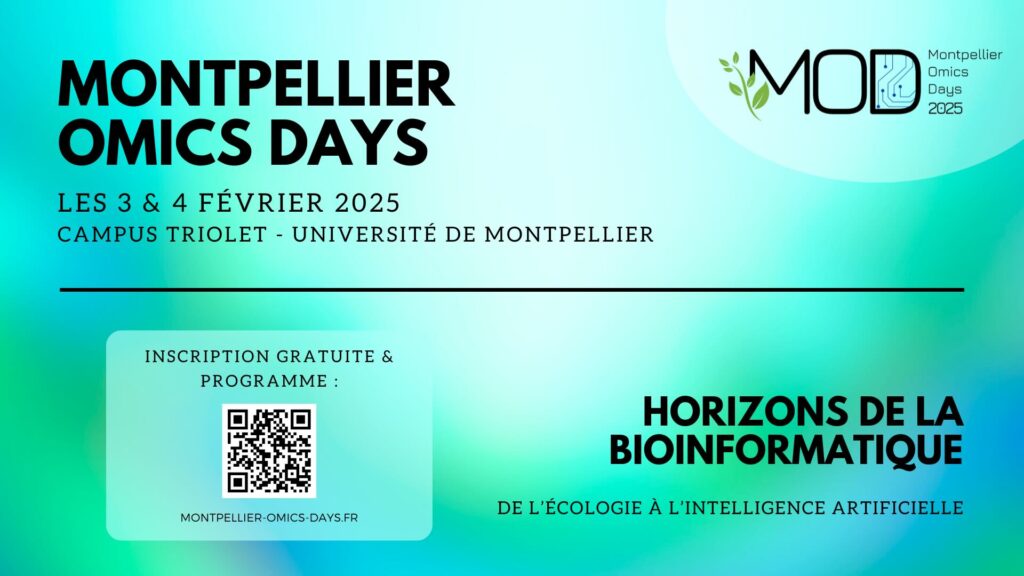
3 février 2025 – 4 février 2025 @ 0 h 00 min –
Campus Triolet, Université de Montpellier
Les étudiants du Master 2 Bioinformatique
Plongez dans l’univers de la bioinformatique et des sciences omiques lors des Montpellier Omics Days, les 3 et 4 février 2025, sur le Campus Triolet de l’Université de Montpellier.Cet événement, organisé par les étudiants du Master 2 Bioinformatique, est l’occasion d’explorer les nouveaux horizons de la bioinformatique, allant de l’écologie à l’intelligence artificielle.
Que vous soyez étudiant, chercheur ou professionnel passionné par la bioinformatique et ses applications, cet événement est fait pour vous !
LabéliséHallesIA
Congrès 2025 du Collège des sociétés Savantes : Sciences – responsabilité – engagement.

3 février 2025 – 4 février 2025 @ 0 h 00 min –
Locaux historiques de la faculté de Médecine de Montpellier
Collège des Sociétés Savantes Académiques de France
Le congrès annuel du Collège est un moment privilégié pour établir des contacts informels, pour tirer partie de notre diversité et pour valider les orientations stratégiques du Collège.
Il se compose d’une demi-journée réservée aux aux représentantes officielles et représentants officiels des membres du Collège (Lundi 3 février après-midi, Université Paul-Valéry-Montpellier, campus Saint-Charles, Avenue Saint Charles) et d’une journée académique (Mardi 4 février, Université de Montpellier, Amphithéatre d’anatomie, bâtiment historique de la faculté de médecine, Rue de l’école de médecine; ouverte à l’ensemble de la communauté académique sur inscription) portant sur un thème transverse à la communauté académique, cette année: «Sciences, responsabilité et engagement : quelles stratégies pour compter dans l’action publique ?».
Congrès 2025 du Collège des sociétés Savantes : Sciences – responsabilité – engagement

3 février 2025 – 4 février 2025 @ Toute la journée –
Le congrès annuel du Collège est un moment privilégié pour établir des contacts informels, pour tirer partie de notre diversité et pour valider les orientations stratégiques du Collège.
Personalizing Treatment with Causal Inference and Scalably Evaluating LLMs in Medicine
3 février 2025 @ 14 h 00 min –
Online
Machine Learning in Montpellier, Theory & Practice
This talk examines two critical aspects of data-driven medicine: personalized treatment strategies using causal inference and the robust evaluation of large language models (LLMs) for clinical applications. In the first part, we present a novel approach to personalized medicine, applying causal statistical learning to observational data to develop individualized treatment rules. We focus on optimizing the timing of renal replacement therapy initiation in acute kidney injury, demonstrating: (i) the estimation and validation of an optimal dynamic strategy, and (ii) a comprehensive framework for evaluating individualized rules using observational data. In the second part, we tackle the challenge of evaluating LLMs in medicine, focusing on the generation of hospital course summaries. Current evaluation methods are often either unscalable (physician-led) or untrustworthy for clinical settings (LLM-as-a-judge). We propose a rubric-based approach to LLM evaluation that combines the scalability of automated methods with the trustworthiness demanded by medical applications, paving the way for responsible deployment of LLMs in healthcare.
Machine Learning in Montpellier, Theory & Practice
Personalizing Treatment with Causal Inference and Scalably Evaluating LLMs in Medicine

3 février 2025 @ 17 h 00 min –
François Grolleau
This talk examines two critical aspects of data-driven medicine: personalized treatment strategies using causal inference and the robust evaluation of large language models (LLMs) for clinical applications.
In the first part, we present a novel approach to personalized medicine, applying causal statistical learning to observational data to develop individualized treatment rules. We focus on optimizing the timing of renal replacement therapy initiation in acute kidney injury, demonstrating: (i) the estimation and validation of an optimal dynamic strategy, and (ii) a comprehensive framework for evaluating individualized rules using observational data.
In the second part, we tackle the challenge of evaluating LLMs in medicine, focusing on the generation of hospital course summaries. Current evaluation methods are often either unscalable (physician-led) or untrustworthy for clinical settings (LLM-as-a-judge). We propose a rubric-based approach to LLM evaluation that combines the scalability of automated methods with the trustworthiness demanded by medical applications, paving the way for responsible deployment of LLMs in healthcare.
Data-driven medicine, LLMs, clinical applications, LabéliséHallesIA